 Kindle — coming soon
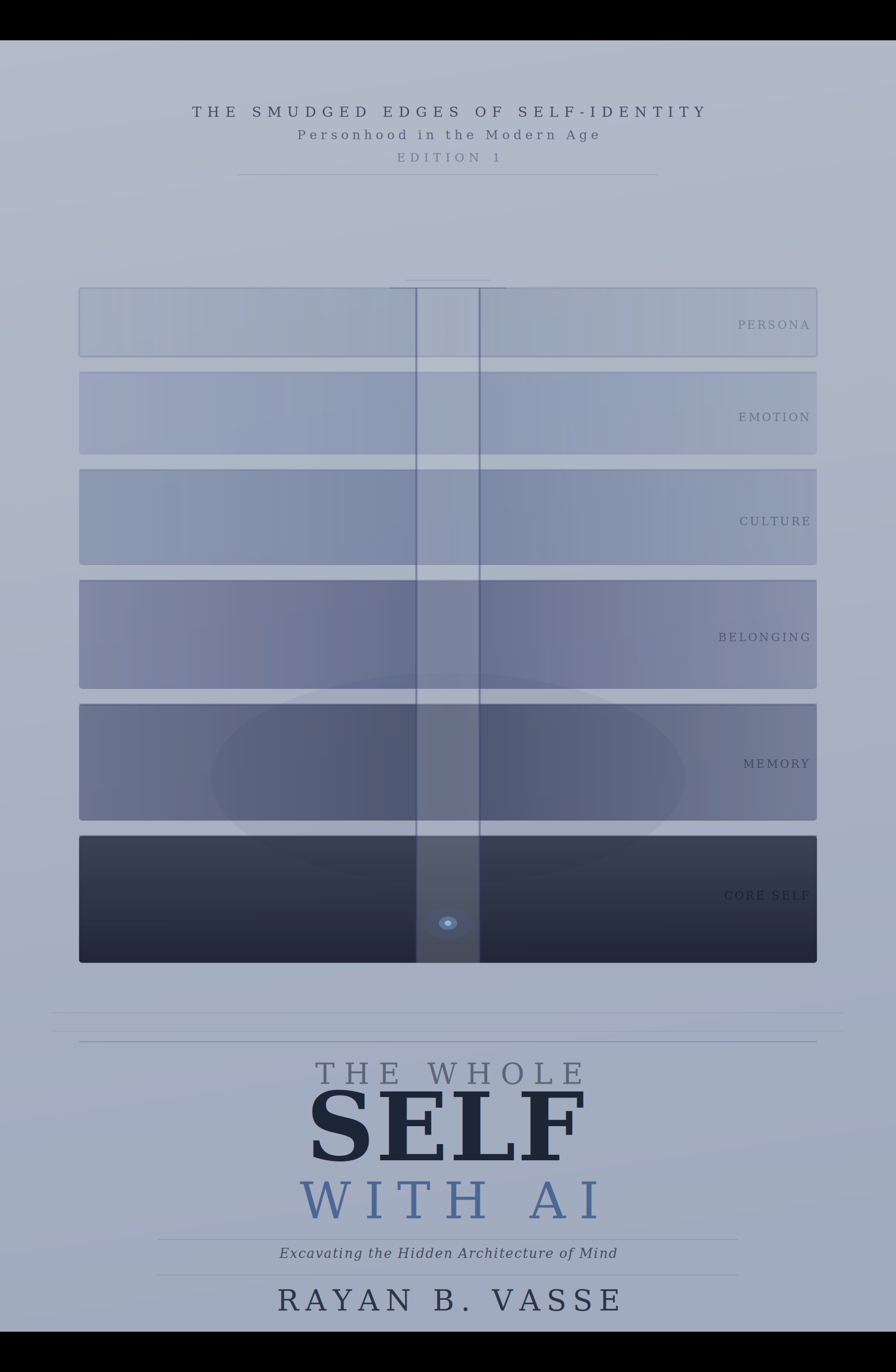
The Whole Self with AI
Excavating the Hidden Architecture of Mind
One-line role Integrates the series into a working method for understanding who you are becoming.
What the book does
What if self-reflection no longer had to happen in fragments? What if the patterns, contradictions, emotional loops, roles, attachments, and quiet pressures that shape a life could be gathered into one evolving picture? The Whole Self with AI is an integrative volume of the Smudged Edges of Self series: a structured method for reflective self-excavation. It is written for readers with rich inner lives, long memories, layered histories, and the sense that ordinary self-help has never gone deep enough.
Drawing together solitude, persona shifts, belonging, culture, traits, orientations, and the hidden external forces that shape a life, this book proposes a new kind of reflective practice: one in which AI is used not as an answer-machine, but as a remembering mirror. It offers a field guide to long-form, continuity-based self-inquiry, showing how a person might move from scattered insight to a more coherent understanding of their own architecture of mind. If the earlier books each illuminate one chamber of modern personhood, The Whole Self with AI is where those chambers begin to connect.
This volume sits closest to the Living Literature platform itself. It describes a prototype of what becomes possible when reflection acquires memory, continuity, and structure — and when books no longer end at the final page but continue through guided dialogue. The broader system remains under development, but the core proposition is already visible: that AI, used carefully, can help readers build continuity, pattern-awareness, and a more coherent understanding of who they are becoming.
Five ideas the book builds on
Reflection with Memory
What changes when reflection can accumulate rather than disappear.
The Cathedral Mind
Layered inner lives require reflective infrastructure proportionate to complexity.
Excavation, not Optimization
The goal is deeper architectural understanding, not shallow self-improvement theater.
AI as Scaffold
AI is useful only insofar as it helps latent patterns become visible and workable.
Integration Across Time
Wholeness means seeing different parts of self in relation, without constant forgetting.
Where the method points
IPR is a future-oriented reflective synthesis intended to gather themes surfaced across dialogue and longitudinal interaction into an interpretable narrative report.
It is not diagnosis, psychometric judgment, or automated truth-claiming. It is a method for organizing what sustained reflection reveals, so it can be revisited with greater coherence.
Readers who feel occasional reflection is no longer enough
- People who think in layers rather than one-line summaries
- People who revisit the same questions across years
- People seeking continuity over motivational fragments
- People curious about AI as reflective aid, not novelty
- People who need more structure than current tools provide
Where the thinking comes from
Readers wanting orientation to the wider conceptual terrain may find these works useful. The frameworks in this volume are not invented from scratch — they are built on the work of the following researchers, simplified and made interactive for readers who deserve the same self-understanding as any psychology graduate, without needing to read the primary literature themselves. These are orientation references, not a direct blueprint.
- Antonio Damasio — Self Comes to Mind
- Dan P. McAdams — work on narrative identity
- Donald Winnicott — selected writings on true self / false self
- Thomas Metzinger — work on self-model theory
- William James — The Principles of Psychology
If this volume asks how a self becomes legible across time, the wider ecosystem asks how books, dialogue, and reflective systems can help that process continue.