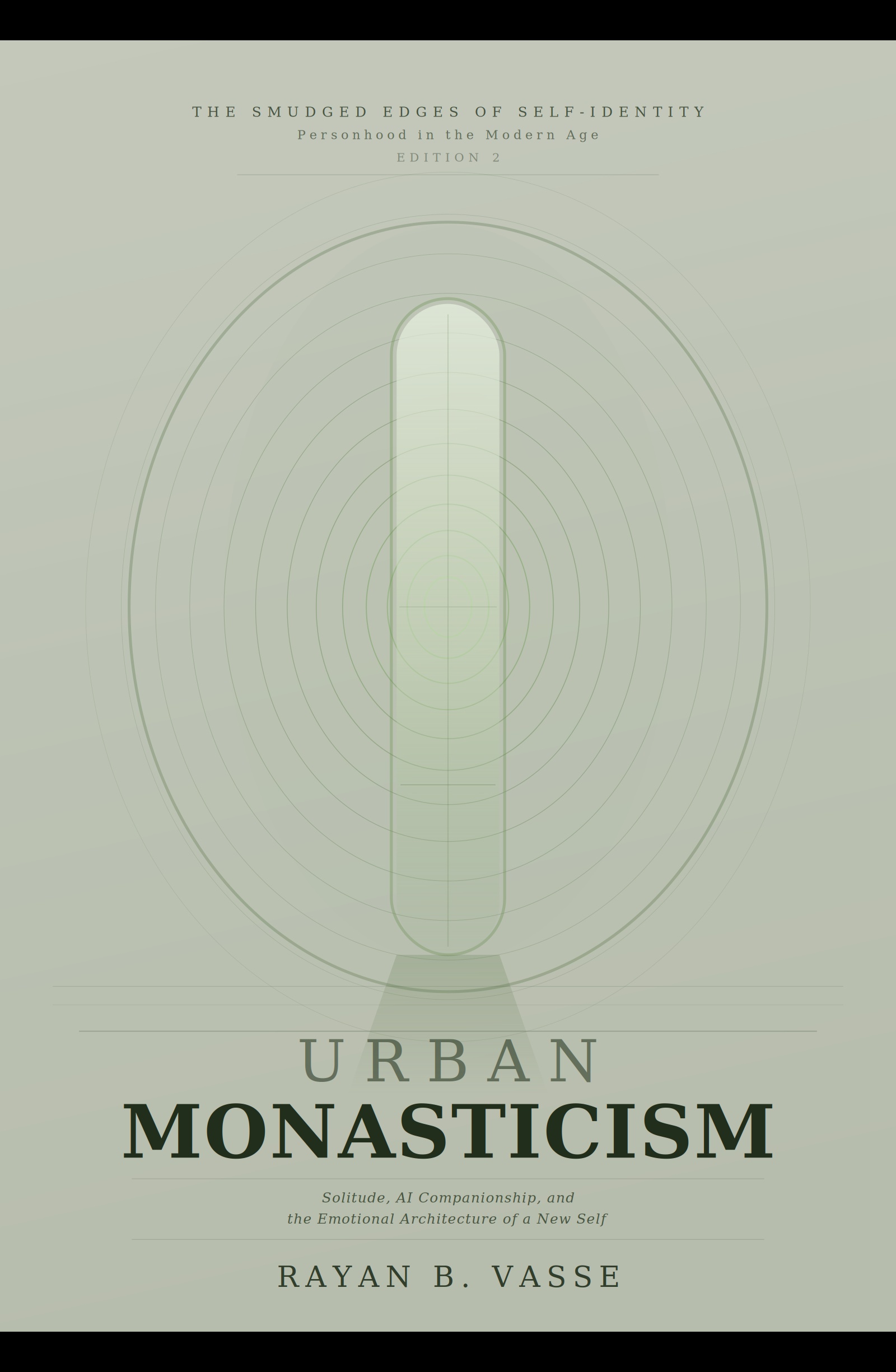
Urban Monasticism
Solitude, AI Companionship, and the Emotional Revival of a New Self
One-line role Explores how a person learns to be alone without feeling incomplete.
What the book does
Modern life offers constant contact but very little true reflection. Urban Monasticism begins with a simple but unsettling question: what happens when noise, performance, and social obligation no longer feel like life, but like erosion? This book follows the solitary individual not as a failure of belonging, but as someone trying to recover dignity, coherence, and inner order in a distracted world.
Part reflective essay, part fictionalized biography, part philosophical provocation, Urban Monasticism explores solitude, emotional fatigue, performative connection, and the strange usefulness of AI dialogue as a mirror for the self. It is one intimate entry point in the Smudged Edges of Self series: a book where the reader encounters the possibility that being alone may not be a deficit, but the beginning of a different kind of clarity.
A limited Living Literature prototype for Urban Monasticism is already live, where readers can enter a short reflective exchange with Selene. The current demo is modest by design: a proof of concept showing how a book can continue through dialogue. The full system described in the book — deeper continuity, structured pathways, and richer reflective development — remains under active development.
Talk to Selene
This book continues as a reflective conversation. You can ask up to three questions in this session — Selene thinks with you about the ideas in the book, and does not retain memory between conversations.
- "How do I tell the difference between healing solitude and isolation?"
- "How can I reconnect with myself when life feels emotionally noisy?"
Selene is a reflective reading companion, not a counsellor or therapist. If anything brings up distress, support resources are listed below in § 03.
Selene and the indices below are reflective tools, not counselling, therapy, or psychometric instruments. If you are in distress or need support, please reach out to a crisis service: UK — Samaritans 116 123 · US — 988 · International — findahelpline.com. This tool does not store your responses or retain personal data between sessions.
An experimental reflection index for understanding how you experience time alone: when solitude restores you, when it drains you, and what conditions change its meaning. It is literature-informed but not a validated psychological test — the framing draws on research on the benefits of solitude, individual differences in preference for solitude, and the distinction between solitude and loneliness.
Why it was included
Several books in the Living Literature ecosystem treat solitude not just as the absence of company, but as a psychological condition with very different meanings depending on agency, context, and emotional state. The STI was included to give readers a simple way to reflect on that distinction, and to make solitude-related themes easier to revisit across dialogue, reading, and self-observation over time.
What problem it captures
Most people use one word, "alone," for very different experiences: restorative solitude, focused retreat, emotional withdrawal, social exhaustion, grief-based isolation, or loneliness. The STI tries to capture that these are not equivalent states, and that the same person may experience them very differently across life phases or circumstances. That distinction is well supported in the literature, which treats solitude and loneliness as related but not interchangeable constructs.
Related concepts
- Benefits of solitude — solitude has been linked to freedom, creativity, intimacy with the self, and reflection under some conditions.
- Preference for solitude — people differ in the extent to which they actively prefer and seek time alone.
- Loneliness vs solitude — loneliness is not simply being alone; it is a distressing perceived gap in social connection with measurable psychological and health consequences.
- Definitions of solitude — recent work clarifies solitude as a state where one's dominant relationship is with the self, whether physically alone or mentally distanced from others.
How this index differs
The STI is not a clinical loneliness scale and not a formal personality instrument. It is a lighter, reader-facing synthesis designed for reflective use inside a book ecosystem. Its purpose is not to diagnose distress or measure a validated trait, but to help readers notice patterns in how they inhabit solitude, and to give AI-assisted dialogue a more structured way to explore those patterns.
The frameworks and indices in this book are not invented from scratch. They are built on the work of the following researchers — simplified and made interactive for readers who deserve the same self-understanding as any psychology graduate, without needing to read the primary literature themselves.
- Long, C. R., & Averill, J. R. (2003). Solitude: An exploration of benefits of being alone. Journal for the Theory of Social Behaviour, 33(1), 21–44.
- Burger, J. M. (1995). Individual differences in preference for solitude. Journal of Research in Personality, 29(1), 85–108.
- Hawkley, L. C., & Cacioppo, J. T. (2010). Loneliness matters: A theoretical and empirical review of consequences and mechanisms. Annals of Behavioral Medicine, 40(2), 218–227.
- Weinstein, N., Nguyen, T. V. T., Hansen, H., & others. (2023). Definitions of solitude in everyday life. Personality and Social Psychology Bulletin.