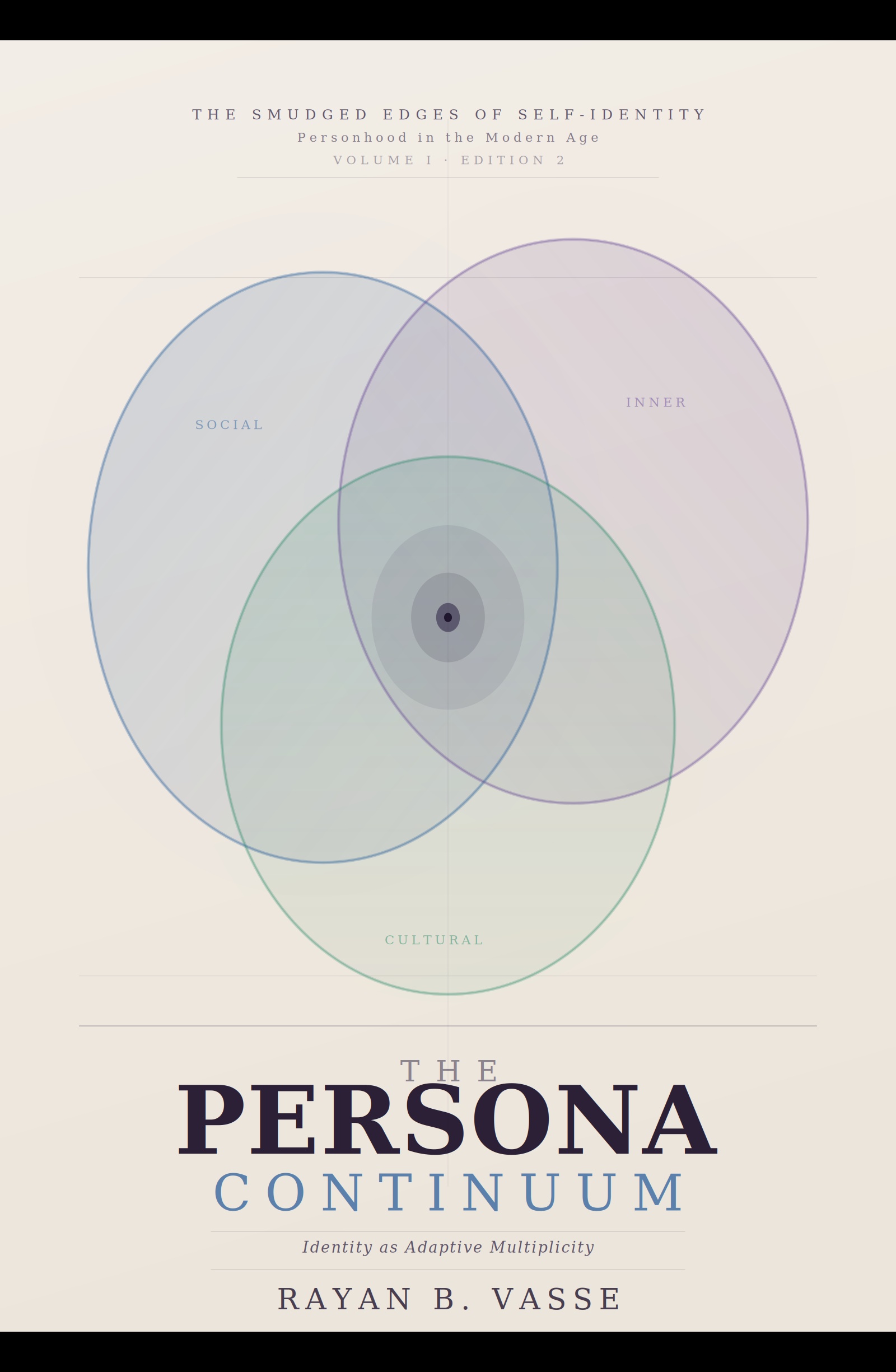
The Persona Continuum
Exploring Synthetic Self-Emulation and the Co-Shaping of Identity
One-line role Reveals how we shift between roles and masks, and what those shifts cost us.
What the book does
Most people already know the feeling: you are one version of yourself at work, another with family, another with old friends, and another again when no one is watching. The Persona Continuum takes that ordinary experience seriously. It argues that the self is not singular and fixed, but fluid, adaptive, and continuously shaped by context, performance, memory, and interaction. Rather than treating these shifts as fakery or pathology, the book explores them as clues to how identity actually works.
Blending psychology, philosophy, lived case material, and emerging AI interaction, The Persona Continuum examines how modern people perform, negotiate, and sometimes lose themselves across roles, platforms, and relationships. It is one of the most conceptually accessible and practically interesting books in the series: a guide to understanding persona shifts, synthetic co-authorship, and the subtle way technology now participates in shaping who we become.
A limited Living Literature prototype linked to this book is available at living-literature.org, where readers can begin exploring persona questions through guided interaction. The current version demonstrates the core idea: that a book can continue as reflective conversation. The fuller system described in the book — deeper persona mapping, structured reflection, and continuity across interactions — remains under development.
Talk to Prometheus
This book continues as a reflective conversation. You can ask up to three questions in this session — Prometheus thinks with you about the ideas in the book, and does not retain memory between conversations.
- "Why do I feel like a different person in different environments?"
- "How do I know when adaptation is healthy versus self-loss?"
Prometheus is a reflective reading companion, not a counsellor or therapist. If anything brings up distress, support resources are listed below in § 03.
Prometheus and the indices below are reflective tools, not counselling, therapy, or psychometric instruments. If you are in distress or need support, please reach out to a crisis service: UK — Samaritans 116 123 · US — 988 · International — findahelpline.com. This tool does not store your responses or retain personal data between sessions.
An experimental reflection index for understanding how your self-presentation shifts across roles and settings, and whether that flexibility feels adaptive or fragmenting. It is literature-informed but not a validated psychological test — the framing draws on classic work on self-presentation, self-monitoring, self-concept clarity, and the "divided self."
Why it was included
Several books in the Living Literature ecosystem treat identity not as a single fixed core, but as something performed, managed, revised, and negotiated across situations. The PFI was included to give readers a structured way to reflect on that movement: not just whether they "change," but how, where, and at what psychological cost or benefit.
What problem it captures
Most people know the feeling of being somewhat different at work, with friends, in family settings, online, or in private. But ordinary language does a poor job distinguishing healthy flexibility from role strain, impression management from self-loss, or contextual adaptation from a divided self. The PFI tries to capture that middle terrain — it is especially concerned with the tension between fluidity and coherence.
Related concepts
- Impression management — classic sociological work treats social life as structured self-presentation, where people manage how they appear in different settings.
- Self-monitoring — some people naturally adapt their expressive behavior more strongly to context than others.
- Self-concept clarity — research distinguishes people with a relatively clear, stable sense of self from those whose self-beliefs feel more uncertain or inconsistent.
- Self-concept differentiation — role-based differences in self-description can sometimes be adaptive, but in other cases relate to poorer adjustment when the self becomes too divided across roles.
How this index differs
The PFI is not a formal personality inventory, not a validated self-monitoring scale, and not a diagnostic measure of identity disturbance. It is a reader-facing synthesis. Its purpose is to translate a complex area of theory into a simpler reflective pathway that can be revisited across dialogue, book engagement, and AI-assisted interpretation. It emphasizes not just context-switching, but the reader's felt relationship to that switching: whether it feels strategic, natural, alienating, or destabilizing.
The frameworks and indices in this book are not invented from scratch. They are built on the work of the following researchers — simplified and made interactive for readers who deserve the same self-understanding as any psychology graduate, without needing to read the primary literature themselves.
- Goffman, E. (1959). The presentation of self in everyday life. New York, NY: Doubleday.
- Snyder, M. (1974). Self-monitoring of expressive behavior. Journal of Personality and Social Psychology, 30(4), 526–537.
- Campbell, J. D., Trapnell, P. D., Heine, S. J., Katz, I. M., Lavallee, L. F., & Lehman, D. R. (1996). Self-concept clarity: Measurement, personality correlates, and cultural boundaries. Journal of Personality and Social Psychology, 70(1), 141–156.
- Donahue, E. M., Robins, R. W., Roberts, B. W., & John, O. P. (1993). The divided self: Concurrent and longitudinal effects of psychological adjustment and social roles on self-concept differentiation. Journal of Personality and Social Psychology, 64(5), 834–846.