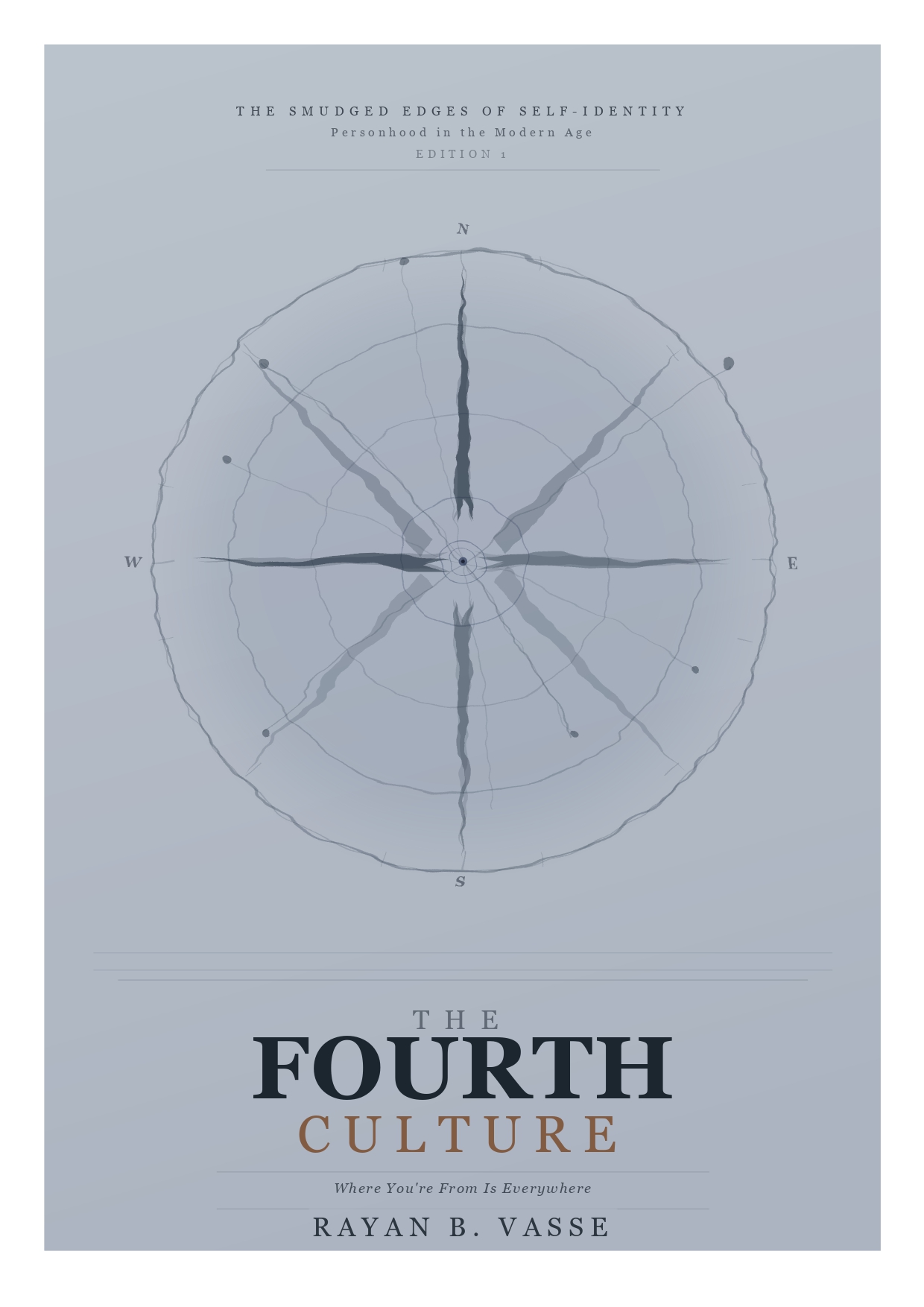
Fourth Culture
Identity Without Borders
One-line role Examines how living across cultures reshapes identity, belonging, and perception.
What the book does
What happens when people share language, schools, cities, and digital spaces, yet still remain subtly outside one another? The Fourth Culture argues that a new identity condition is emerging: not simply migrant, not simply local, not simply "third culture," but something more fluid, layered, and emotionally unresolved. This book gives that condition a name. It is written for readers who have lived between geographies, languages, moral systems, and social codes — and for anyone trying to understand why belonging in the modern world so often feels partial, negotiated, and unstable.
Grounded in migration research, identity theory, digital culture, and the large Spanish–Latin American corridor, The Fourth Culture moves from concept to lived reality. It shows why the old models explain only fragments, while Fourth Culture names the pattern itself: fluent yet foreign, connected yet unseen. This is the series volume that expands the project from the individual to the social world — and from theory to a research and platform horizon.
Where this book points next
Unlike Urban Monasticism and The Persona Continuum, this book does not have a reader-facing companion. Its extension lies instead in the research and platform vision behind it.
The Atlas that grows out of this book
Fourth Culture opens directly toward the Global Narrative Atlas — an AI-assisted, longitudinal, multilingual observatory of people living between cultures, languages, and digital worlds. Where the book names the pattern, the Atlas is designed to track it: moving beyond one-off surveys and static labels toward a living map of identity in motion.
Readers, researchers, educators, and potential collaborators who see the value of such a system are invited to follow its development.
Visit the Global Narrative Atlas →The work beneath the book
The index below is a reflective tool, not counselling, therapy, or a psychometric instrument. If you are in distress or need support, please reach out to a crisis service: UK — Samaritans 116 123 · US — 988 · International — findahelpline.com. This tool does not store your responses or retain personal data between sessions.
An experimental reflection index for understanding belonging across more than one cultural world: heritage, host culture, language, and identity compatibility. It is literature-informed but not a validated acculturation test — the framing draws on major acculturation theory, bidimensional models such as the Vancouver Index of Acculturation, and bicultural identity integration research.
Why it was included
Several books in the Living Literature ecosystem deal with migration, hybridity, multilingual life, and belonging that does not resolve neatly into one category. The CCI was included to give readers a structured way to reflect on cultural layering without forcing them into simplistic binaries like "assimilated" or "not assimilated." It is meant to make complex cross-cultural experience more discussable across reading, reflection, and AI-assisted dialogue.
What problem it captures
Most everyday language for culture is too blunt. It misses the fact that someone can be highly connected to a heritage culture and also highly adapted to a host culture, or feel culturally competent in two worlds while still experiencing deep identity tension between them. The CCI tries to capture that middle terrain: layered belonging, cultural compatibility, and the difference between external adaptation and internal integration.
Related concepts
- Acculturation as multidimensional — classic work shows that adaptation to a new culture is not one simple continuum, but can involve integration, assimilation, separation, or marginalization.
- Bidimensional cultural orientation — the Vancouver Index of Acculturation and related work assess heritage orientation and mainstream orientation separately rather than as opposites.
- Bicultural Identity Integration — research shows that two cultural identities may be experienced as compatible and blended, or as oppositional and in conflict.
- Third Culture / cross-cultural upbringing — the TCK tradition provides a widely recognized descriptive framework for lives shaped by mobility, mixed cultural codes, and diffuse belonging.
How this index differs
The CCI is not a formal acculturation inventory, not a validated intercultural competence scale, and not a diagnostic measure of adaptation. It is a reader-facing synthesis. Its purpose is to translate a broad field of cross-cultural theory into a simpler reflective structure for people living culturally layered lives. Compared with many existing measures, it puts more emphasis on lived hybridity, internal compatibility, and longitudinal self-understanding rather than only static group comparison.
The frameworks and indices in this book are not invented from scratch. They are built on the work of the following researchers — simplified and made interactive for readers who deserve the same self-understanding as any psychology graduate, without needing to read the primary literature themselves.
- Berry, J. W. (1997). Immigration, acculturation, and adaptation. Applied Psychology, 46(1), 5–34.
- Ryder, A. G., Alden, L. E., & Paulhus, D. L. (2000). Is acculturation unidimensional or bidimensional? A head-to-head comparison in the prediction of personality, self-identity, and adjustment. Journal of Personality and Social Psychology, 79(1), 49–65.
- Benet-Martínez, V., & Haritatos, J. (2005). Bicultural identity integration: Components and psychosocial antecedents. Journal of Personality, 73(4), 1015–1050.
- Pollock, D. C., Van Reken, R. E., & Pollock, M. V. (2009). Third Culture Kids: Growing Up Among Worlds. Nicholas Brealey.