 Kindle link coming soon
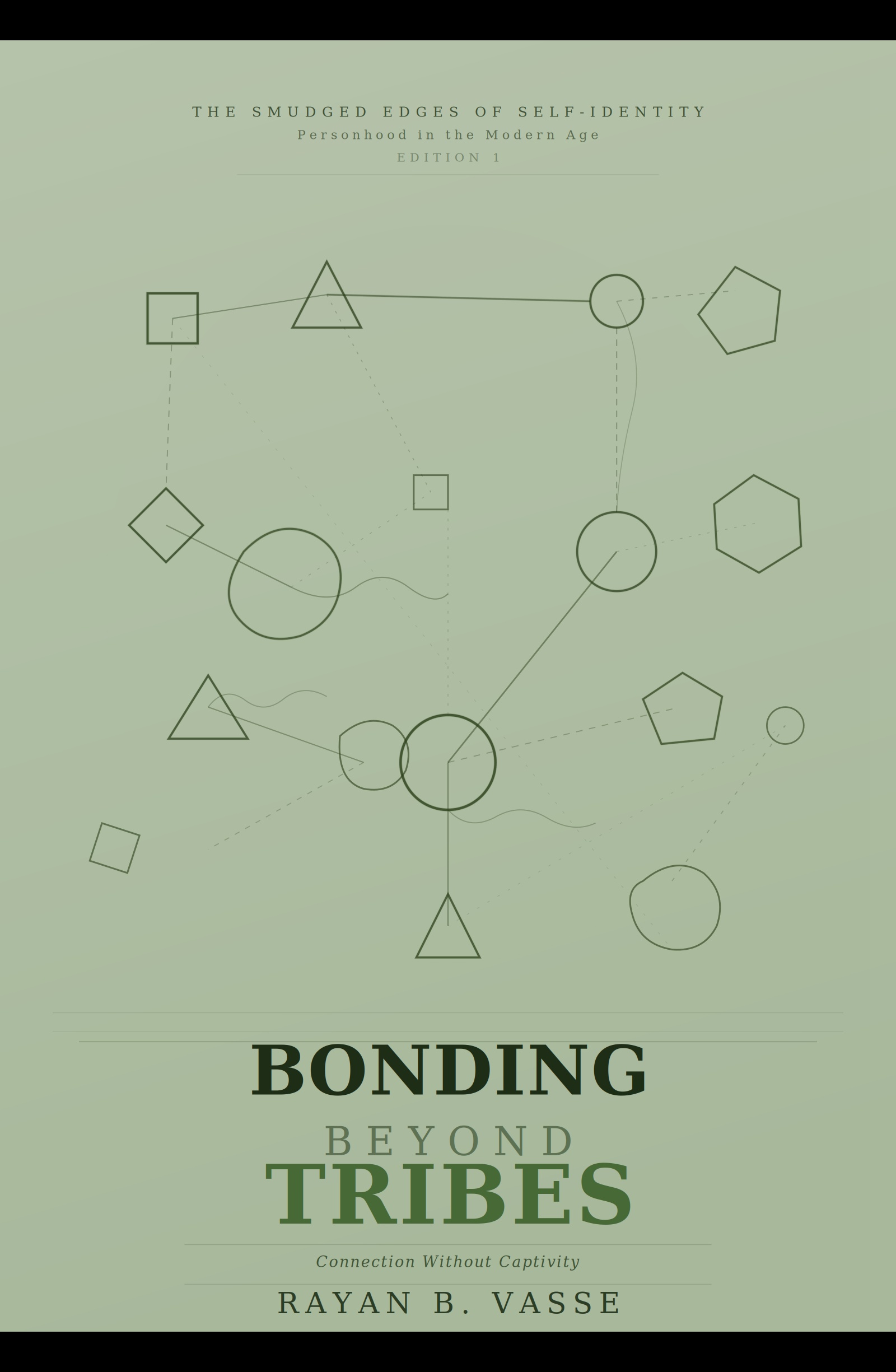
Belonging Beyond Tribes
Connection Without Captivity
One-line role Challenges the assumption that belonging is always good, exposing its hidden costs.
What the book does
We are taught that belonging is healing, necessary, and unquestionably good. Belonging Beyond Tribes asks a far more uncomfortable question: what if belonging is also one of the quietest ways people lose themselves? What if family, friendship, workplaces, religion, nation, and community do not only protect identity, but also shape, constrain, and sometimes erode it? This is the sharpest and most confrontational volume in the series — the one that stops treating belonging as a virtue and starts examining its price.
Drawing on psychology, anthropology, neuroscience, and close observation of modern social life, this book examines the invisible bargains people make to stay accepted: the roles they perform, the truths they suppress, the dignity they trade for peace, access, or attachment. It introduces the possibility of another path — one that preserves connection without surrender, and closeness without captivity. If you have ever felt that fitting in came at too high a cost, this book will not reassure you. It will name what you already sensed.
This book forms part of the wider Living Literature system under development, where readers will be able to explore their own bonding style, social thresholds, and patterns of belonging through guided reflection with AI companions. The current project extends beyond the page — inviting readers not only to understand belonging differently, but to examine how it has shaped their own lives.
The index below is a reflective tool, not counselling, therapy, or a psychometric instrument. If you are in distress or need support, please reach out to a crisis service: UK — Samaritans 116 123 · US — 988 · International — findahelpline.com. This tool does not store your responses or retain personal data between sessions.
An experimental reflection index for understanding how you relate to groups, communities, and shared identities — and what kinds of belonging feel supportive versus constraining. It is literature-informed but not a validated psychological test. The framing draws on the belongingness hypothesis, social connectedness research, need-to-belong work, and relatedness theory. It is meant to help readers reflect on the tension between connection and autonomy, rather than assume that more belonging is always better.
Why it was included
Several books in the Living Literature ecosystem treat belonging as psychologically necessary but not always psychologically simple. The BTI was included because many readers are not simply asking, "Do I belong?" but also, "What kind of belonging costs me too much?" and "How much of myself do I give away in order to remain included?" The index is meant to create a structured reflective space for those questions.
What problem it captures
A great deal of research shows that belonging is a fundamental human motive, but the lived experience of belonging varies widely. Some forms of belonging support regulation, motivation, and well-being, while others demand masking, over-accommodation, or group dependence. The BTI tries to capture that difference: not only whether belonging is present, but how it is organized, how strongly it is needed, and whether it feels secure, conditional, chosen, or coercive.
Related concepts
- Belongingness hypothesis — classic work argues that human beings have a fundamental motivation to form and maintain stable, meaningful interpersonal bonds.
- Social connectedness and social assurance — belonging can involve both felt connection and a more reassurance-seeking dependence on social acceptance.
- Need to belong / relatedness — later work distinguishes the strength of belonging motives and links them to well-being, adjustment, and relational functioning.
- General belongingness / acceptance vs rejection — some scales frame belonging partly through inclusion and partly through the experience or expectation of exclusion.
How this index differs
The BTI is not a validated belongingness scale, not a full attachment measure, and not a formal social identity inventory. It is a reader-facing synthesis. Its emphasis is slightly different from many standard instruments because it focuses not only on whether belonging is desired or present, but on the style and cost of belonging: whether the person's connection to groups feels nourishing, conditional, dependent, avoidant, or autonomy-eroding. In that sense it is trying to make a complex literature more usable for reflective dialogue and book-based self-inquiry.
The frameworks and indices in this book are not invented from scratch. They are built on the work of the following researchers — simplified and made interactive for readers who deserve the same self-understanding as any psychology graduate, without needing to read the primary literature themselves.
- Baumeister, R. F., & Leary, M. R. (1995). The need to belong: Desire for interpersonal attachments as a fundamental human motivation. Psychological Bulletin, 117(3), 497–529.
- Lee, R. M., & Robbins, S. B. (1995). Measuring belongingness: The Social Connectedness and the Social Assurance Scales. Journal of Counseling Psychology, 42(2), 232–241.
- Leary, M. R., Kelly, K. M., Cottrell, C. A., & Schreindorfer, L. S. (2013). Individual differences in the need to belong: Mapping the nomological network. Scale tradition summarized in later reviews and derivative measures.
- Malone, G. P., Pillow, D. R., & Osman, A. (2012). The General Belongingness Scale (GBS): Assessing achieved belongingness. Personality and Individual Differences.
- Deci, E. L., & Ryan, R. M. (2000). The "what" and "why" of goal pursuits: Human needs and the self-determination of behavior. Psychological Inquiry, 11(4), 227–268.